

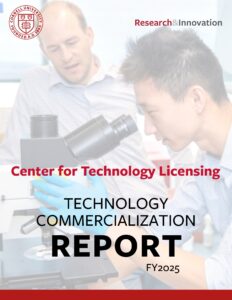
CTL works diligently with Cornell researchers and innovators by bringing their inventions from the lab to the marketplace. As Cornell’s technology commercialization office, we are exploring new ways to create business opportunities, launching new ventures, and helping to commercialize Cornell technologies. Learn more about CTL’s annual activities and metrics.
Click the button below to review online or download the complete FY25 Annual Report.
View and download here
FY25 at a Glance
Leadership Message
Fiscal Year 2025 was a year of substantial progress for Cornell’s Center for Technology Licensing (CTL). This annual report goes beyond metrics—we are proud to share the narratives behind those numbers, spotlighting the inventors, startups, and partnerships that make innovation possible.
Twenty new startups based on university technologies were launched, the highest in Cornell history, bringing the five-year total to 75. Our overall startup portfolio collectively raised $450 million in FY25—a strong result given the current climate—contributing to more than $2.4 billion raised over the past five years. We executed 93 licenses and options in FY25, forging partnerships with both established corporations and emerging ventures. The featured inventor story of Professor Iwijn De Vlaminck illustrates how Cornell innovations succeed through both licensing agreements and startup creation.
We continued to strengthen pathways for early-stage technologies through gap funding programs. The Ignite gap funding series, featured in the first Ignite Impact Report released alongside this annual report, has become a cornerstone of Cornell’s innovation ecosystem. Ignite has generated more than $42 of follow-on funding for every $1 invested, 38 new licenses and options have been executed for technology commercialization, and 32 startups have secured significant funding for growth. At Weill Cornell Medicine, the Catalyst Fund was launched to support multiple asset pillars at different development stages, helping accelerate development across the board.
These successes reflect the close engagement with Cornell inventors. We modernized the disclosure process by launching a new online system that streamlines intake and reduces administrative burden for inventors across all campuses. We also strengthened engagement through programs such as Cornell Innovation & Venture Advisors (CIVA) and the Lab to Impact event series, building deeper connections between researchers, industry leaders, and investors.
What makes these accomplishments more meaningful is that they were achieved under challenging circumstances. Amid a university-wide hiring pause and financial constraints, our team performed while understaffed and under-resourced. That resilience speaks to the strength of Cornell’s innovation community and its unwavering commitment to impact.
Looking ahead, we are optimistic. CTL is establishing a OneCornell portfolio framework across 13 technology and industry pillars to improve strategic management and marketing, leveraging gap funding to de-risk early-stage innovations, and supporting partners to accelerate commercialization. Our goal remains clear: to translate discoveries into solutions that improve lives, strengthen industry partnerships, and generate returns that fuel reinvestment in research.

Alice Li
Executive Director
CTL

Lisa Placanica
Senior Managing Director
CTL at Weill Cornell Medicine
FY25 Facts & Figures
Commercializing
93
Licenses & Options
FY2021-2025:
497 Licenses & Options
$22 M
Revenue Generated
FY2021-2025:
$122M Revenue Generated
Venturing
20
New Startups Based on Cornell IP
FY2021-2025:
75 New Startups
$462 M
Funding Raised by Startups in FY25
FY2021-2025:
$2.4B Funding Raised by Startups


















A Cornell Tech Runway program startup at the Jacobs Institute.
Accelerating
110
Cumulative Ignite Gap Funding Projects
$42 to $1
Follow-on Funding
Protecting
138
US Non-Provisional Patent Filings
96
US Patents Issued
Ideating
95
Educational Programming
293
IP Disclosures
Commercial Reach & Impact Snapshot
880
Active licenses encompassing 1,150+ technologies
540
Industry Partners
4.2K
Active patents & patent applications U.S. and foreign
$5.4B
Cumulative startup funding raised
FY25 Featured Inventor: Iwijn De Vlaminck
Advancing partnerships and startups to maximize chance of commercial success

“My motivation is to ensure that our lab’s innovations don’t stop at papers and grants, but ultimately reach the real world and improve human health. The Center for Technology Licensing has been an invaluable partner in helping make this happen. There is still much work ahead—and that’s exactly what excites me.”
At Cornell, innovation thrives when research follows a clear path to market. Associate Professor Iwijn De Vlaminck exemplifies this approach. Known for his pioneering work in precision medicine technologies, De Vlaminck doesn’t just invent — he actively engages to help shape how discoveries reach industry and patients.
From the earliest stages of technology development, De Vlaminck has partnered closely with the Center for Technology Licensing (CTL), contributing to intellectual property protection, market strategy and engagement with industry. His proactive involvement ensures that promising inventions advance through the most effective commercialization pathway— whether through licensing to established corporations or launching new ventures.
That balanced perspective sets him apart. De Vlaminck supports each technology based on its merits and market potential, resulting in a portfolio that spans both worlds. His lab’s RNA technology was licensed to Illumina in FY25, and an earlier agreement with Eurofins Genomics extended Cornell’s impact in molecular diagnostics. These partnerships bring Cornell innovations to researchers and clinicians worldwide.
At the same time, De Vlaminck is a dynamic entrepreneur. He co-founded Kanvas Biosciences, a successful startup advancing microbiome-based therapeutics, and recently launched Romix Biosciences with Dr. Conor Loy, an Ignite Fellow for New Ventures, who graduated in August 2025. By leveraging gap funding and startup resources at Cornell, he accelerates the transition from concept to company—demonstrating how Cornell faculty can leverage the innovation ecosystem to turn ideas into ventures that attract investment and drive product development.
De Vlaminck’s story is a model for innovation at Cornell: engage early, collaborate deeply with tech transfer and industry, and support the commercialization path that maximizes impact. His commitment to translating science into solutions—through both industry partnerships and startups—shows what’s possible when inventors embrace flexibility and work hand-in-hand with Cornell’s innovation ecosystem.
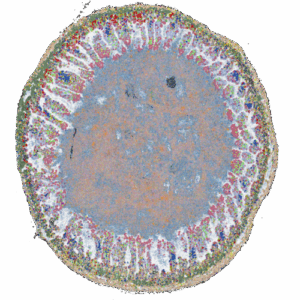 An image of the gut microbiome in the mouse intestine generated using a patented sequencing method developed in the laboratory of Iwijn De Vlaminck, associate professor in the Meinig School of Biomedical Engineering at Cornell University. Image courtesy of the De Vlaminck Lab.
Advancing Innovations Through Gap Funding
Cornell’s gap funding programs are designed to propel early‑stage technologies across the critical “valley of death,” providing milestone‑driven support that reduces technical and commercial risk and accelerates translation. This framework ensures that high‑potential discoveries mature into deployable solutions with clear pathways to licensing, partnerships, and venture growth.
Ignite Lab to Market
Ignite provides targeted, milestone driven funding and acceleration programs that enable inventors and founders to reduce technical and commercial risk and transition innovations into deployable technologies—increasing value and reaching the next inflection point with clear results that justify further engagement from corporate partners and investors. The program also helps grow entrepreneurs and startup teams, building the human capital essential for long term venture success.
Metrics Highlight
$231M
Follow-on Funding
42-to-1
Ratio for every Ignite dollar
38
New licenses & options for technology commercialization
32
Startup companies secured significant funding for growth

Enterprise Innovation Catalyst Fund
Weill Cornell Medicine has launched the Enterprise Innovation Catalyst Fund, an expanded version of the longstanding Daedalus Fund, to strengthen support for early-stage research and accelerate commercialization. Made possible by a generous gift from Richard and Amy Ruben, the Catalyst Fund creates an umbrella structure for three tiers of gap funding — Proto Stage, Breakout Stage, and Validation Stage — designed to help inventors validate ideas, de-risk technologies, and prepare projects for industry and investor partnerships. The program builds on more than a decade of Daedalus’ success and broadens Enterprise Innovation’s ability to retain expert consultants, engage external advisors, and deliver tailored educational programming.
FY25 Outreach & Engagement
This year, CTL consolidated and refocused engagement efforts across Cornell’s campuses and beyond, bringing researchers, industry partners, investors, and entrepreneurs together to accelerate the path from discovery to impact. Through diverse outreach events and programs, CTL created several touchpoints for innovators to receive guidance, build connections, and advance their technologies toward commercialization.
Cornell Innovation & Venture Advisors (CIVA)
An exclusive community of industry experts and investors who receive a first look at emerging technologies and venture opportunities.
42
Innovations presented at CIVA
160
External CIVA members
15
Presentations in FY25
13
Follow-on Funding
Lab to Impact IP & Commercialization Series

CTL’s cornerstone educational program designed to equip Cornell researchers and innovators with the knowledge, tools, and confidence to engage in commercialization.
9
Lab to Impact events in FY25
320
Attendees
Ignite Connect 2025

CTL’s flagship annual virtual partnering program highlighting a curated portfolio of university-born technologies and venture teams that have progressed beyond concept validation and into investable projects.
16
Presentations
150
Attendees
20
Networking sessions
Biomedical Innovation Conference (BioInnovate)

Weill Cornell Medicine’s flagship biomedical innovation conference brings together scientists, founders, investors, and industry leaders to explore how discoveries move from research to patient care through founder pitches, expert panels, and high-impact networking.
203
Attendees
50
Investors & industry partners represented
70
Introductory meetings
Dean’s Symposium on Innovation & Entrepreneurship

An annual gathering that spotlights real-world commercialization journeys of Weill Cornell Medicine clinicians and scientists—from invention and IP to startup formation and patient impact—through panels and fireside conversations.
8th
Annual symposium
8
Faculty inventors featured
90
Attendees from research, clinical care and industry