

Highlights of “Where’s the Edge? Opportunities in the Future of Computing from the Core to the Moon and Beyond”

Where's the Edge? Nov 18th Panel


On Nov. 18th, the Center for Technology Licensing at Cornell University, the Praxis Center for Venture Development, Silicon Catalyst, and Red Bear Angels hosted a panel with semiconductor luminaries to discuss and share their experience in the industry.


Moderated by Rick Bahr, Adjunct Professor at Stanford University and investor at Silicon Catalyst, the panelists included Alex Behfar, Chairman and Chief Executive Officer of Odyssey Semiconductor Technologies, Inc., Shahin Farshchi, Partner at Lux Capital, Veerbhan Kheterpal, CEO, Co-founder, quadric.io, Inc., and Doug Kirkpatrick, CEO of Eridan, Inc.


The panel addressed the moment of resurgence for the semiconductor industry and provided insights into commercializing new ideas. Behfar, Kheterpal, and Kilpatrick detailed how they found their beachhead, particularly Kheterpal addressed the subject in the crowded field of machine learning platforms. Farshchi brought his perspective as an investor and offered insight into the VC industry’s aversion to risk. As an investor, Farshchi discussed how technologies must be de-risked, provide considerable benefits to the customer, and show a significant potential for market penetration.


Watch the panel discussion below.


Where’s the Edge? – Panel


The panel also included pitches from Cornell emerging semiconductor startups Geegah, LLC, OWiC Technologies Inc., and Soctera, Inc. The founders performed their pitches in front of the panelists and an audience of angel investors.


Geegah, OWiC, and Soctera, collectively, demonstrate the broad range and depth of new semiconductor opportunities-based technologies licensed from Cornell University,” said Robert Scharf, Director of the Praxis Center for Venture Development. “Each team identified a discrete value proposition and target market, and they are all working diligently to perfect their product-market fit and bring their minimum viable products to commercial success.”


Mr. Scharf encouraged the audience to reach out to collaborate and support the Cornell startup community to make the transition from the academic world to the commercial world.


Watch the pitches of Cornell emerging startups incubated at the Praxis Center for Venture development:


Where’s the Edge – Geegah Pitch


Where’s the Edge – OWiC Pitch


Where’s the Edge – Soctera Pitch


Please join the CTL newsletter. Be in the know for upcoming Cornell startups and CTL events.
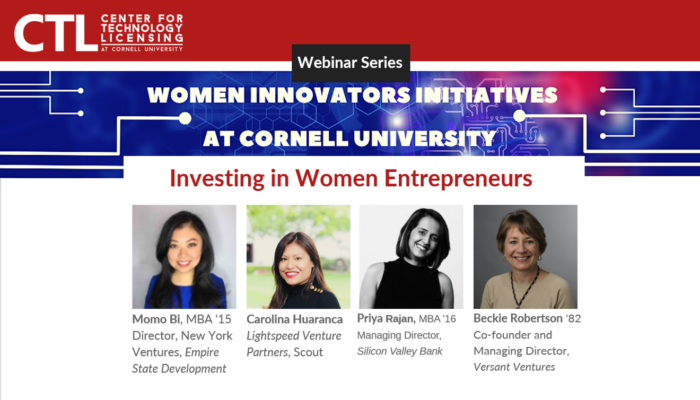
Insights on Investing Into Women Entrepreneurs

How do we increase investment into women entrepreneurs, and how can we help promote women into leadership roles?

The Center for Technology Licensing (CTL) recently explored answering those questions in a webinar with four distinguished Cornell alumni: Momo Bi ’15, Carolina Huaranca Mendoza, Priya Rajan ’16, and Beckie Robertson ’82.

Momo Bi ’15 is an investor at New York Ventures, New York state’s capital fund. Bi first started her career in B2B software sales but wanted to better understand business in general. Bi entered the Cornell Johnson Business School and graduated in 2015. After graduation, Bi joined JP Morgan for a year but left to work directly with business founders. From there, New York Ventures recruited Bi into her current position.

Carolina Huaranca Mendoza is currently a scout for Light Speed Venture Partners. Mendoza attributes her non-linear career path to her professor from the ILR School and following a thread of access that allowed her to work in startups and various business sectors. Through her network and strategic career choices, Mendoza landed her current position as an investor.

Priya Rajan ’16 is the Managing Director at Silicon Valley Bank. Before her current position, Rajan was following a traditional career path in finance as an accountant. While attending the Cornell Johnson Business School, Rajan realized she had access to great businesses and investors that she felt she wasn’t utilizing. Rajan approached her CFO at Silicon Valley Bank and explained she wanted to work in venture investment. Her executives supported her new career direction, and Rajan has been in her current role for over six years.

Beckie Robertson ’82 is a chemical engineer who moved to California for her first job in biomedical engineering. She landed a position at a startup called Lifescan, which became a multibillion-dollar division of Johnson & Johnson. From that experience, Beckie developed her interest in entrepreneurship. Beckie credits her trusted network of mentors she utilized to launch her startups and finally enter the venture capital industry. Robertson is also a Trustee at Cornell University.

The webinar entitled “Investing in Women Entrepreneurs” held on 09/30/2020 was the second in the Women Innovators Initiative series devoted to engaging, empowering, and growing women faculty, staff, and graduate students towards technology innovation and entrepreneurial leadership.

In the webinar, Rajan presented a Silicon Valley Bank study that found that only about 14% of startups in the US have female CEOs. Only about 30% of startups have programs geared toward developing women into leadership roles. Rajan noted that the numbers have been increasing year over year, but the desire for a multifold increase in those numbers resonated with the panelists and audience alike.

During the panel, Robertson, Bi, Mendoza, and Rajan all shared their views on the ideal entrepreneurial traits, the importance of networking, and finally, dealing with gender bias in the workspace.

Robertson states the trait that is most important in being an entrepreneur is to be a “…completely ruthless truth seeker.” Robertson explains that when you start a company, “…if you aren’t always probing for the truth… you’re going to miss the mistakes that you’re making.”

Listen to Beckie Robertson talk about being a “Being a Completely Ruthless Truth Seeker.”

On networking, Bi advises if you have an entrepreneurial idea, “Just try it…talk to as many people as you can.” Mendoza followed with, “…you need to put yourself out there… (you need) to share your magnificence with people.” Robertson finishes up the thought with “It’s a numbers game…do not be discouraged if the first ten people do not return you call.”

Watch all the panelists talk about networking and advice on being entrepreneurial.

An audience member asked the panelists for advice on dealing with gender bias in the workspace. Rajan and Bi gave helpful strategies and tactics derived from their real-world experience. Robertson advised, “Find your own voice…develop confidence in your own voice.” Robertson shared from her board room experience that her most effective voice was “playing the role of helping people hear each other.”

Watch the panelists discuss dealing with gender bias and finding your voice.

The full webinar can be seen on CTL’s YouTube channel here: https://www.youtube.com/watch?v=s3wL9Zd1VRY

To learn more about CTL’s Women Innovators Initiative and more information on the next WI2 webinar please go here:

A Panel of Cornell Alumni Addressed their Perspectives on Women Inventorship and the Growing Supporting Ecosystem at Cornell University

Shockingly, only 12% of the inventors nationally are women. How do we go about improving our innovation ecosystem to increase the number of women faculty and graduate student inventors?

The Center for Technology Licensing (CTL) recently explored answering this question in a webinar with four distinguished Cornell alumni: Dr. Pam Marrone ’78, Ponsi Trivisvavet ’99, Dr. Anaïs Rameau ’04, and Beth Xie ’10.

Pam Marrone, Ph.D., founder, and CEO of Marrone Bio Innovations, after significant experience in an agricultural biotechnology corporation, left the corporate world to set out on an entrepreneurial path. In her entrepreneurial career, she started three biotech companies and has over 500 patents worldwide.

Ponsi Trivisvavet, MBA, CEO of Inari Agriculture, Inc., has a similar path to Pam Marrone. She first started her career at a large global agriculture company. Looking to innovate in her field, she decided to start her own startup company and develop new technologies in the ag-tech space.

Anaïs Rameau, M.D., surgeon, and faculty at Weill Cornell Medicine, as well as CEO and co-founder of MyophonX, have found her inspiration in practicing medicine and inventorship from her mother, who holds several patents and is a medical doctor.

Beth Xie, MBA, tech entrepreneur, startup advisor, and investor was the CEO and co-founder of TaggPic, a startup based on Cornell technology focused on delivering image and location intelligence from real-time analytics. Beth led TaggPic from its inception as an invention all the way to its acquisition by Google.

The webinar entitled “Women Inventors at Cornell University: Creating and Growing an Ecosystem of Innovation” held on 6/25/2020 was the first in a new series devoted to showcasing women inventors and identifying steps to encourage, inspire and facilitate more women inventors at Cornell University.

Alice Li, Executive Director at CTL and moderator of the panel, started the discussion by offering striking statistics concerning the matter at hand. Nationwide women represented 12% of the inventors listed in U.S. patents (source: USPTO, 2016) while at Cornell University, the data are more optimistic with 23% of female faculty who are inventors. However, there is still a lot to do.

By sharing their stories and providing genuine lessons learned into their journey as inventors, entrepreneurs, and leaders, the discussion converged toward the importance of mentoring, toward the importance of purpose in one’s entrepreneurial journey, and toward the importance of celebrating the lesser-known women who have succeeded in their field.

“Two things I learned along the way…actually not change yourself, be yourself…being a woman is not a weakness, it’s a strength.” – Ponsi Trivisvavet

During the discussions the panelists each related on being the only or one of the few women in the room in their respective fields. Xie said that women have to be prepared for this challenging but rewarding journey. They all encouraged the audience to seek both female and male mentors. Trivisvavet recounted that having a male mentor helped her gain understanding from a different perspective. She advised the audience to “Be yourself…don’t try to act like others…” and rather than trying to fix your weakness, “…one should focus on building your strengths.” She completed her thought by stating “…being a woman is not a weakness it’s a strength!”

Besides, as leaders, Marrone and Trivisvavet shared the importance of diversity in their team. 50% of Inari’s and Marrone Bio Innovations’ employees are women.

They all concurred as Rameau emphasized that now is the time for women to be an inventor and an entrepreneur.

Listen to all the panelist’s insights on being an inventor and entrepreneur in the video below.

Listen to all the panelist’s thoughts on building an ecosystem of women inventorship in the video below.

To watch the “Women Inventors at Cornell University” webinar in its entirety click here.

The next Women Inventor Initiative panel addressing “Inventing in Women Entrepreneurs” will be held on 9/30 and is featuring:
* Beckie Robertson ’82, Co-founder and Managing Director, Versant Ventures
* Momo Bi, MBA, Director, New York Ventures, Empire State Development
* Priya Rajan, MBA ’16, Director, Early Stage Practice, Silicon Valley Bank. Advisor at Xfund.
* Carolina Huaranca Mendoza, Principal & Advisor, Kapor Capital
Register for the upcoming webinar here.